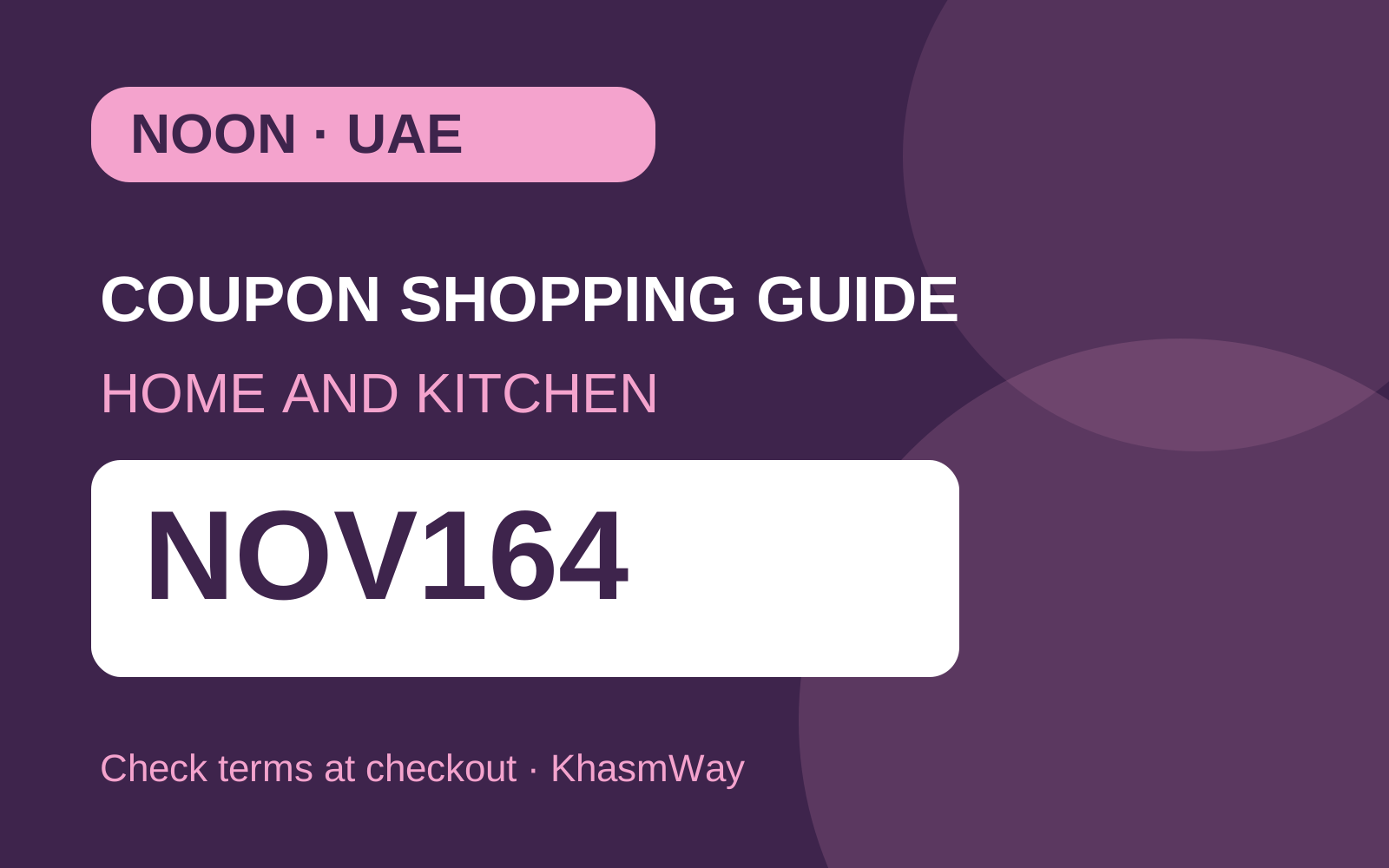
Noon UAE coupon NOV164 2026-11-01: Home and Kitchen for household needs — Delivery and returns
This independent guide does not guarantee a discount. Check code NOV164 and eligibility in the Noon cart.
Procuring home and kitchen essentials online within the United Arab Emirates requires a systematic evaluation of regional logistical infrastructure, residential building protocols, and regional utility standards. Successful purchasing begins with verifying that products align with the physical and technical demands of UAE properties, which operate on a 220 to 240-volt electrical standard at 50Hz using British Standard 1363 (Type G) three-pin plugs, alongside specific plumbing thread sizes for water-connected units. Delivery logistics in the Emirates are defined by architectural differences between high-density urban residential towers in commercial hubs like Dubai and Abu Dhabi and low-rise gated communities across the Northern Emirates. Navigating these deliveries requires coordinating with property security, reserving service elevators, securing property gate passes, and understanding courier scheduling windows to ensure large parcels, delicate dinnerware, and climate-sensitive appliances arrive safely.
Managing returns for household goods across the UAE involves adhering to strict reverse logistics processes governed by the Ministry of Economy consumer protection frameworks and merchant-specific guidelines. Because reverse logistics can be complicated by regional factors—such as re-packaging large appliances, handling courier pickups in gated developments, and processing non-returnable hygiene items like bed linens or opened food-contact tools—buyers should document the condition of deliveries immediately. Unboxing kitchen tools, major appliances, and fragile tableware requires rapid physical inspection, retaining all original packaging materials, and confirming serial numbers before discarding transit pallets or protective styrofoam. Integrating these pre-order spatial checks, electrical audits, and unboxing protocols creates a predictable, risk-mitigated shopping workflow that protects household investments and streamlines post-purchase claims.
The UAE Household Logistics Landscape: Delivery Realities Across Emirates
The delivery journey for home and kitchen merchandise across the United Arab Emirates encompasses several distinct logistical environments. In high-density metropolitan zones like Downtown Dubai, Dubai Marina, Business Bay, and Al Reem Island in Abu Dhabi, the primary logistical hurdles center around vertical transit and municipal vehicle staging. High-rise residential towers operate with strict building management regulations. Delivery couriers carrying oversized boxes containing kitchen islands, flat-pack pantries, or multi-burner ranges cannot simply stop curbside. They must navigate designated loading docks, register with security desks by depositing an Emirates ID or commercial driver pass, and utilize designated service elevators. Many premium towers restrict heavy household deliveries to specific daytime windows, usually between 09:00 and 17:00 on weekdays, completely barring freight movement on weekends or public holidays to minimize noise for tenants.
In contrast, low-rise residential configurations, such as the master-planned villa communities of Arabian Ranches, Jumeirah Golf Estates, Yas Island, and Khalifa City, present entirely different operational constraints. In these neighborhoods, last-mile couriers navigate private perimeter gates where security guards verify resident authorization prior to grant entry. Delivery vans must adhere to community speed controls and local parking restrictions that prevent blocking narrow residential lanes. A major challenge in newly constructed developments across Dubai South, Al Furjan, or expanding sectors of Sharjah and Ajman is the absence of finalized municipal street numbering on standard mapping platforms. In these areas, buyers must provide pinpoint digital maps, local community district identifiers, and building or villa numbers alongside the Makani geographic coordinate number to avoid missed delivery appointments or misrouted items.
Inter-Emirate transit logistics add another operational layer when home and kitchen items are fulfilled from central distribution warehouses located in industrial hubs like Jebel Ali Free Zone (JAFZA), Dubai Industrial City, or Sharjah Industrial Area. Deliveries dispatched to the Northern Emirates—including Ras Al Khaimah, Umm Al Quwain, and Fujairah—often run on consolidated regional trucking schedules rather than on-demand, same-day routes. Buyers residing outside main logistics corridors should anticipate longer transit times for bulky items like heavy cookware sets, large trash compactors, and freestanding refrigeration units. These goods require specialized freight transport rather than standard motorcycle or light courier dispatch, making real-time order tracking and milestone notifications essential for household planning.
Technical and Utility Compatibility for Kitchen and Household Goods
Sourcing home and kitchen products internationally or across regional e-commerce stores introduces the risk of buying merchandise that conflicts with UAE domestic infrastructure. The electrical grid throughout all seven Emirates delivers alternating current at 220 to 240 volts with an operating frequency of 50 Hz. Sockets universally support the British Standard 1363 (Type G) configuration featuring three rectangular prongs arranged in a triangular shape, incorporating an integrated circuit fuse. Procuring small kitchen electronics—such as high-speed blenders, immersion circulators, air fryers, and espresso machines—engineered for 110-120V/60Hz North American power profiles creates severe operational and fire hazards. Running these appliances on UAE voltage profiles causes internal electrical burnouts, catastrophic motor failure, or tripped residual current circuit breakers, simultaneously voiding any manufacturer warranty.
Direct water-connected equipment, such as under-sink reverse osmosis (RO) filtration modules, countertop ice makers, plumbed espresso stations, and automatic dishwashers, requires careful inspection of pipe sizing and thread specifications. In the UAE, residential plumbing fittings adhere primarily to British Standard Pipe (BSP) threading conventions, typically with half-inch (1/2") or three-quarter-inch (3/4") external connections. Appliances imported from regions adhering to National Pipe Thread (NPT) standards cannot achieve a watertight seal against BSP threaded brass angles without specialized adapters. Mismatched threads risk micro-leaks, elevated water pressure damage, and long-term structural moisture accumulation beneath cabinetry, which accelerates mold proliferation in regional climates.
Desalinated municipal water is standard across the Emirates, featuring specific dissolved mineral profiles that dictate appliance maintenance schedules and filtration demands. Countertop electric kettles, steam ovens, garment steamers, and ultrasonic humidifiers accumulate calcified scale more rapidly when fed directly with unfiltered tap water. This calcium carbonate accumulation degrades heating elements, impedes thermal conductivity, and causes boiler solenoid valves to seize. Shoppers investing in premium kitchen gear must account for multi-stage water softening or mineral extraction cartridges to protect their equipment and comply with maintenance guidelines required for regional returns or warranty claims.
Categorical Purchasing Breakdown: Cookware, Small Appliances, and Major White Goods
Cookware and Bakeware
Selecting cookware suitable for UAE homes depends heavily on heat source compatibility, thermal durability, and transit vulnerability. A growing number of residential developments have phased out open-flame liquefied petroleum gas (LPG) infrastructure in favor of glass-ceramic induction or electric radiant cooktops. When buying cookware sets, verify magnetic base responsiveness for induction by confirming the pan contains a 400-series magnetic stainless steel outer disc or solid cast-iron base. Multi-clad stainless steel (such as 18/10 interior with an aluminum core) offers balanced heat diffusion and prevents warping under intense temperature swings. Non-stick coatings should be PTFE-free or reinforced ceramic compounds capable of enduring high-temperature sautéing. Because raw cast iron and heavy carbon steel easily chip fragile enamel layers during rough parcel transport, insist on protective void-fill and internal padding during delivery checks.
Countertop Small Appliances
Small kitchen electronics represent the highest volume of e-commerce home merchandise, but they also show the highest post-delivery return rates due to performance issues or misjudged physical sizes. When assessing food processors, stand mixers, and blenders, prioritize commercial-grade motor wattages (800W to 1500W) equipped with internal thermal overload cutoffs. The ambient heat inside UAE distribution hubs and delivery vehicles can elevate ambient plastics to elevated baselines; motors lacking integrated thermal breakers can overheat during prolonged processing cycles. Ensure that small appliances feature food-grade, BPA-free tritan plastics or borosilicate glass containers capable of enduring repeated high-temperature sanitization cycles in domestic dishwashers without cracking or clouding.
Major White Goods and Refrigeration
Procuring large appliances like refrigerators, freezers, washing machines, and dishwashers online demands an understanding of international climatic classifications. Major cooling appliances operate under designated climate classes: SN (Subnormal), N (Normal), ST (Subtropical), and T (Tropical). For reliable cooling in the UAE, where ambient kitchen or storage temperatures can rise whenever central air conditioning is turned off, always select appliances rated Climate Class T (Tropical: +16°C to +43°C). Compressors engineered strictly for Class N or SN struggle to maintain correct internal temperatures during the warmest months. This leads to continuous motor operation, accelerated compressor wear, higher electric bills, and food spoilage. Confirm that external appliance housing features corrosion-resistant coatings or galvanized steel backing to counteract coastal humidity.
Appliance and Cookware Comparison Matrix
| Category | Technical Standard | UAE Domestic Suitability | Logistical Vulnerability | Return Complexity |
|---|---|---|---|---|
| Multi-Ply Cookware | Magnetic 18/10 Stainless Steel; Induction Compatible | High; compatible with induction, radiant glass, and gas hobs | Low; resistant to drops, though enameled surfaces can chip | Low; standard parcel courier drop-off or pickup |
| High-Speed Blenders | 220-240V, 50Hz; Type G Plug; Minimum 1000W Motor | High; ideal for diverse domestic culinary use | Moderate; glass jars require secure internal cushioning | Moderate; requires all blades, tampers, and inner seals intact |
| Class T Refrigerators | Climate Class T; Inverter Compressor; BSP Plumbing Inlet | Critical; needed to withstand ambient UAE summer heat profiles | High; requires upright transit, uncrating, and balance checks | High; requires freight transport, team lifts, and gate passes |
| Countertop Ovens | 220-240V, 50Hz; Double-pane tempered glass door | Moderate; heat dispersal requires adequate counter clearance | Moderate; glass panels are susceptible to transit shock | Moderate; packaging must be kept fully intact |
| Under-Sink RO Units | 1/2" or 3/8" BSP connections; 3 to 6 Bar pressure rating | High; addresses municipal water mineral hardness | Low; composite filter housings are light but need thread checks | High; cannot be returned once water has run through membranes |
Pre-Order Spatial Measurements and Architectural Audits
A primary driver of non-defective household item returns across the UAE is dimensional failure: the item physically cannot fit into its intended kitchen footprint or cannot pass through the property's access points. Before confirming an order for freestanding side-by-side refrigerators, large range cookers, or kitchen islands, map the entire journey the delivery team must take. Begin at the building unloading bay or street gate. Measure service elevator door widths, interior car depth, car height, and internal weight capacities. In older low-rise buildings without dedicated service lifts, measure stairwell landings, ceiling drop-downs, and handrail clearances to ensure two-person delivery teams can navigate corners without dropping heavy items or damaging interior walls.
Inside the apartment or villa, check every interior passage, including main entry doorways, narrow hallway necks, and kitchen entrance openings. Remember to account for projecting door handles, baseboard trim, and light switches, which reduce clearance margins by two to five centimeters. For built-in kitchen cabinetry, examine standard counter depths (typically 60 centimeters in modern UAE residential developments) against the appliance's chassis depth, excluding front handles and door swing radiuses. Built-in dishwashers, microwaves, and under-counter wine chillers require dedicated rear ventilation margins—typically five to eight centimeters—to prevent hot air build-up that triggers safety cutoffs and damages surrounding melamine or wood veneer surfaces.
Finally, trace the required utility access points relative to the planned appliance placement. A plumbed refrigerator or dishwasher positioned beyond the reach of standard 1.5-meter factory supply hoses requires specialized extensions. This setup increases water-leak risks if routed behind hot ovens or sharp cabinet corners. Verify that dedicated Type G wall sockets are situated within direct reach of factory electrical cords; running heavy kitchen appliances on light-duty extension leads is dangerous and violates local civil defense safety standards.
Unboxing, Structural Inspection, and Immediate Order Verification
The first thirty minutes following parcel delivery are critical for establishing whether an item is intact and eligible for return. For parcel-based deliveries brought by local motorcycle couriers or light vans, inspect the outer carton before signing the digital Proof of Delivery (POD) terminal. Note any crushed corrugated edges, puncture marks, or torn tape directly on the carrier’s electronic delivery manifest. If an outer package shows significant damage suggesting rough handling of fragile ceramics or glassware, photograph the box from several angles prior to opening it.
Follow a structured inspection sequence when opening the product packaging:
- Preserve the Packaging Materials: Cut security tape cleanly with a utility knife rather than tearing the cardboard flaps. Retain the master box, custom styrofoam inserts, molded pulp trays, plastic film, cable wraps, and accessory cartons. Discarding this protective packaging can void standard return policies or trigger restocking deductions under merchant terms.
- Perform a Surface Inspection: Check non-stick cookware coatings for scratches, look for surface hairline fractures on ceramic bakeware, inspect stainless steel appliances for dents, and verify that oven door glass sits squarely within its frame without loose hinges.
- Audit Accessories and Components: Match package contents against the printed manufacturer user manual inventory. Check that all blender lids, rubber gaskets, drip trays, filter baskets, splash guards, instruction manuals, and specialized connection fittings are present. Missing components should be reported to the retailer within twenty-four to forty-eight hours of delivery.
- Conduct a "Dry" Electrical Test: Plug the appliance into an isolated wall socket before filling it with water or food ingredients. Turn on the unit to verify that digital LED panels illuminate, control knobs click accurately, and basic heat or motor cycles engage smoothly. Running a dry cycle prevents contaminating the machine with food residue, keeping it eligible for standard returns if an electrical fault is found immediately.
Returns, Reverse Logistics, and UAE Consumer Protections
Consumer commerce throughout the United Arab Emirates is governed by Federal Law No. 15 of 2020 on Consumer Protection, alongside its executive regulations. This legal structure protects consumers against defective, non-conforming, or counterfeit goods. Under these regulations, consumers are entitled to repair, replacement, or a complete refund if a delivered product displays a manufacturer defect or deviates substantially from its advertised technical specifications. However, the legislation differentiates between genuine product defects and discretionary "change of mind" returns, leaving discretionary policies to the commercial terms set by individual e-commerce platforms.
Reverse logistics for large household items require careful coordination. Unlike simple drop-off returns for apparel at parcel lockers, returning a 70-kilogram front-load washing machine or multi-pan cast-iron cookware set requires scheduling an on-site courier collection. The buyer must pack the item securely inside its original internal foam and box structure to prevent transit damage during the return trip. If an item is damaged on its way back because it was inadequately packaged, the merchant can reject the return claim and send the product back to the buyer at the buyer's expense. For villa communities or access-controlled towers, you will need to book an elevator or clear a gate pass for the reverse courier team, just as you did during initial delivery.
Special hygiene exclusions apply across household and kitchen retail categories. Items that come into direct contact with food or human skin—such as vacuum sealers, meat grinders, personal blenders, bed pillows, mattress protectors, and opened cut-to-size shelf liners—are non-returnable once their protective seals are broken, unless a mechanical failure can be proven. Thoroughly review the category return terms on the merchant's portal before opening vacuum-sealed accessories or removing tamper-evident tape from food-contact surfaces.
Payment Options and Accurate Checkout Formatting
Executing an online purchase for home and kitchen supplies across the UAE involves selecting payment methods and entering location details tailored to the country's infrastructure. Payment ecosystems generally offer three main options: direct credit/debit card processing, Buy Now Pay Later (BNPL) platforms, and Cash on Delivery (COD). While COD remains an option for small household items, it introduces operational friction for large appliances or high-value cookware. COD orders often require exact cash amounts at the doorstep, incur supplementary courier collection fees, and result in delayed bank refunds if the item is returned, because the merchant must manually process an electronic wire transfer to the buyer's IBAN rather than reversing a card charge.
Digital debit and credit payments provide clean digital paper trails and simplify chargeback dispute resolutions if a supplier fails to fulfill an order or breaches delivery windows. When using installment plans like Tabby or Tamara, be aware of how returns are handled. If an item is returned and approved by the merchant, the credit is usually applied back through the BNPL ledger to zero out future installments or refund paid amounts. However, processing timelines can take anywhere from three to fourteen business days depending on the financial institutions involved.
Address formatting requires strict attention. Because traditional residential zip codes or postal codes are not used for door-to-door courier deliveries in the UAE, entering placeholder codes (such as "00000") in postal fields is standard. To ensure timely delivery, structure your delivery address using the following format:
- Full Recipient Name and Active UAE Mobile Number: Couriers rely heavily on phone calls or automated WhatsApp messages to confirm location pins prior to dispatch.
- Emirate and District: State the exact Emirate (e.g., Dubai, Abu Dhabi, Sharjah) along with the specific neighborhood or master community (e.g., Jumeirah Lakes Towers, Mohammed Bin Rashid City, Al Nahda).
- Street Name or Sector/Cluster: Specify the local street name, sector number, or cluster letter (e.g., Cluster V, Street 14, Zone 2).
- Building Name and Apartment Number / Villa Number: Clearly distinguish between flat numbers in multi-story towers and standalone villa plots.
- Makani Number: Where available, provide the 10-digit unique Makani geographic number assigned by municipal authorities to the building or villa entrance, ensuring accurate navigational routing.
Applying Promotional Incentives at Checkout
E-commerce checkout platforms often include promotional voucher interfaces that allow shoppers to apply incentives before finalizing their payment. Applying these codes correctly requires strict adherence to system instructions so the checkout software can recalculate cart totals accurately.
- Add your selected home and kitchen products to the digital shopping cart, confirming that each item matches UAE electrical and plumbing standards.
- Navigate to the cart summary or checkout payment window where order values, delivery fees, and tax assessments are itemized.
- Locate the field labeled "Promo Code," "Voucher," or "Discount Code."
- Enter the promotional code NOV164 into the text entry box without any spaces, extra punctuation, or altered capitalization.
- Click the "Apply" or "Submit" button to trigger the cart balance recalculation.
- Review the balance breakdown to verify that the code registered successfully against eligible products before entering payment details and confirming the purchase.
Promotional incentives operate within precise administrative limits. Certain manufacturer agreements exclude specific premium consumer electronics, commercial refrigeration lines, or clearance items from promotional field redemptions. Furthermore, codes cannot be stacked on top of other vouchers or applied retroactively once the financial transaction is confirmed. Take a moment to review all product exclusions and terms to ensure the code applies properly to your cart contents.
Climate Influences and Appliance Longevity
The climate across the United Arab Emirates features prolonged periods of extreme ambient heat and elevated coastal humidity, punctuated by occasional airborne dust and sand. These environmental realities affect both the transit of goods and their day-to-day operation. During peak summer months, interior cargo temperatures in standard non-climate-controlled courier vans can climb past 55°C. Products containing soft plastics, silicone spatulas, synthetic rubber gaskets, or heat-sensitive electronic displays are vulnerable to thermal warping or adhesive degradation if left inside transport vehicles for extended periods. Inspect these soft materials immediately upon delivery to ensure seals, gaskets, and plastic elements have not warped or softened in transit.
Dust and fine suspended sand particles also affect high-draw kitchen electronics that rely on active air cooling fans, such as countertop induction hobs, multi-cookers, and microwave ovens. Fine dust can accumulate on internal circuit boards, insulating thermal sensors and causing premature component failure. To extend appliance lifespan, clean air vents periodically with dry microfiber towels or soft brush attachments, and avoid placing air-cooled appliances directly next to open balcony doors or windows.
The combination of coastal humidity and desalinated tap water creates an aggressive environment for kitchen metals. Lower-grade ferritic stainless steels (such as 430 grade) used in entry-level dish racks, paper towel holders, and decorative shelving are prone to surface corrosion or pitting over time. Choose austenitic stainless steels (such as 304 or 18/8 and 18/10 grades) or powder-coated aluminum fixtures for areas near sinks, prep counters, and dishwashers. Taking these climate considerations into account helps you build a durable, easy-to-maintain kitchen setup tailored to the regional environment.
Pre-Purchase Decision Framework
Before confirming an order for home or kitchen items, work through this pre-purchase decision tree to avoid costly delivery issues, structural mismatches, or complicated reverse returns:
1. Electrical and Technical Assessment
- Does the appliance run on 220-240 Volts at 50Hz without needing an external step-down transformer?
- Is the power cable equipped with an authentic, fused Type G three-pin plug that complies with BS 1363?
- For large cooling appliances, is the compressor certified under Climate Class T (Tropical) for hot running environments?
- Do water-line fittings match local British Standard Pipe (BSP) thread specifications?
2. Architectural and Spatial Clearances
- Have you measured the entire delivery path—service lift car, stair landings, doorways, and interior hall turns?
- Does the kitchen counter offer enough depth to maintain adequate ventilation behind the appliance?
- Are wall power sockets accessible without using intermediate extension cords or adaptors?
3. Logistical and Property Verification
- Have you checked your building management's delivery rules regarding move-in permits, gate passes, or designated delivery times?
- Is a service elevator reservation required to bring bulky items up to your floor?
- Does your shipping profile include your full district, building name, apartment or villa number, active mobile number, and Makani number?
4. Return Eligibility and Policy Terms
- Is the item classified as non-returnable once opened due to food hygiene or personal contact rules?
- Can you store the original packaging, custom foam, and transport pallet during the standard trial period?
- Does the retailer provide home collection for reverse freight, or does returning an item require customer drop-off at an industrial parcel depot?
Reviewing these factors before placing an order eliminates common purchasing errors, protects your home from utility mismatches, and guarantees that your new kitchen and household goods arrive safely, fit perfectly, and perform reliably for years to come.
Frequently asked questions
Does code NOV164 guarantee savings?
No. Check the eligibility and actual discount in the Noon cart before paying.
How can I confirm the code is applied?
Enter the code at checkout and verify that a discount actually appears in the order summary.
Are coupon terms identical in both countries?
Not necessarily. Check the official store terms for your country.